


I don’t think anyone watching an antitrust trial has ever seen anything like the last week. On Monday, as we reported, the Department of Justice and Ticketmaster/Live Nation agreed to settle the case, which shocked Judge Arun Subramanian, fellow state plaintiffs, and even the DOJ’s lead attorney on the case.
When the federal settlement was announced, these states declared that the terms of the deal were inadequate and vowed to “keep fighting this case without the federal government.” They insisted to the judge, however, that they would need 60 days to prepare in the absence of the DOJ. Rather than grant the delay, the judge sent the parties into five days of forced negotiations.
During this period, some state attorneys general decided to settle with Live Nation. So far, Arkansas, Iowa, Mississippi, Nebraska, Oklahoma, South Carolina and South Dakota have either settled with Live Nation or indicated their plan to do so.
The terms of the settlement are a far cry from the relief initially sought: the breakup Live Nation and Ticketmaster. The current deal aims to reduce Live Nation’s power in the industry, mainly through behavioral remedies. Live Nation/Ticketmaster will give up control of 13 amphitheaters across the country, limit its exclusive ticketing contracts to four years, cap ticketing fees at 15 percent and allow venues to sell a portion of secondary tickets through other ticketing services (if they so choose).
The settlement also requires that the company pay damages of up to $280 million to plaintiff states, which amounts to 1.1 percent of what the company made in 2025. Lawyers for Live Nation said that this provision was written with the expectation that all plaintiff states would settle, so it is unclear what the settling states will now receive.
For Live Nation, this deal appears to be a win. Last Monday, following the news of the settlement, its shares rose by at least 6 percent. But the case is far from over. First, for the settlement to be finalized, Judge Subramanian must review the agreement and determine whether it is in the public interest (a process called the Tunney Act).
And second, the rest of the plaintiffs haven’t agreed to end litigation. A bipartisan group of 33 state attorneys general did not settle and announced that they will officially be moving forward with the antitrust trial starting Monday. The decision marks a major moment for this case. A week ago, the DOJ was leading the plaintiffs’ arm of litigation. Now, mid-trial, the plaintiffs have splintered: the DOJ is no longer part of the trial team, and a remaining group of states has taken over as the sole plaintiffs arguing before the jury.
The jury, which has been off for the past week, will return, and the trial will resume exactly where it left off, in the middle of the direct examination of one of the plaintiffs’ key witnesses, the CEO of AEG, the second largest live concert promoter. What remains of his direct testimony will be led by a lawyer he has never met in person.
For the first time since the trial began, the DOJ team will not be seated at the plaintiffs’ table. In their place will sit state attorneys general and their newly retained co-lead counsel, Jeffrey Kessler and his team from Winston & Strawn. Kessler has a long career in anti-trust litigation, and it’s hard to overstate the impressiveness of his track record. He helped litigate against the NFL to establish free agency, he successfully arguing the landmark case to the Supreme Court against the NCAA that opened the door to NIL payments for college athletes, and he recently defeated NASCAR in a case brought by Michael Jordan. This guy’s a winner. That said, it’s unclear how effective the state litigation effort will be with such a rush job.
Why are Certain States Determined to Push Forward?
The states are moving forward because they believe the DOJ-Live Nation settlement does not address the broader structural issues that are core to the monopoly claims. The 2010 consent decree, which allowed Live Nation and Ticketmaster to merge, included anti-retaliation provisions meant to prevent the company from using its market power to disadvantage competitors. In 2019, the DOJ concluded that Live Nation “repeatedly and over the course of several years engaged in conduct that, in the Department’s view, violated” the consent decree. As a result, the DOJ and Live Nation agreed to extend the consent decree and modify its terms.
And yet, the original lawsuit brought by the DOJ and this consortium of states alleged that Live Nation was nonetheless able to maintain a monopoly.
In other words, the states still pursuing the case are unconvinced that another set of conduct rules and some divestiture in the industry will meaningfully change Live Nation’s power over the live concert market.
“Robbing them blind”
If the public was not already on board with the plaintiffs of this case, text messages between Live Nation employees released this week appear to have done the job. These exchanges, a few of which I’m including below, were written in 2022 by Ben Baker and Jeff Weinhold, both of whom worked as regional ticketing directors for Live Nation amphitheaters at the time. Baker now serves in a more senior role and is expected to testify in this trial.
They effectively reveal “behind-the-scenes” conversations about tactics to up-charge fans through ancillary fees, like as parking and seating upgrades.
Exchange One
Baker: These people are so stupid
Weinhold: I have VIP parking up to $250 lol
Baker: I almost feel bad taking advantage of them
Exchange Two
Baker: I charge $50 to park in the grass lmao
charge $60 for closer grass
Weinhold: VIP parking was supposed to be 5/5. I now START at $100
Baker: 5/5 for one way valet
$100 for oversize which doesn’t give you ANY benefits theres no RV plug in’s AND you still ahve to walk 3/4 of a mile
hahahaha
Baker: lol
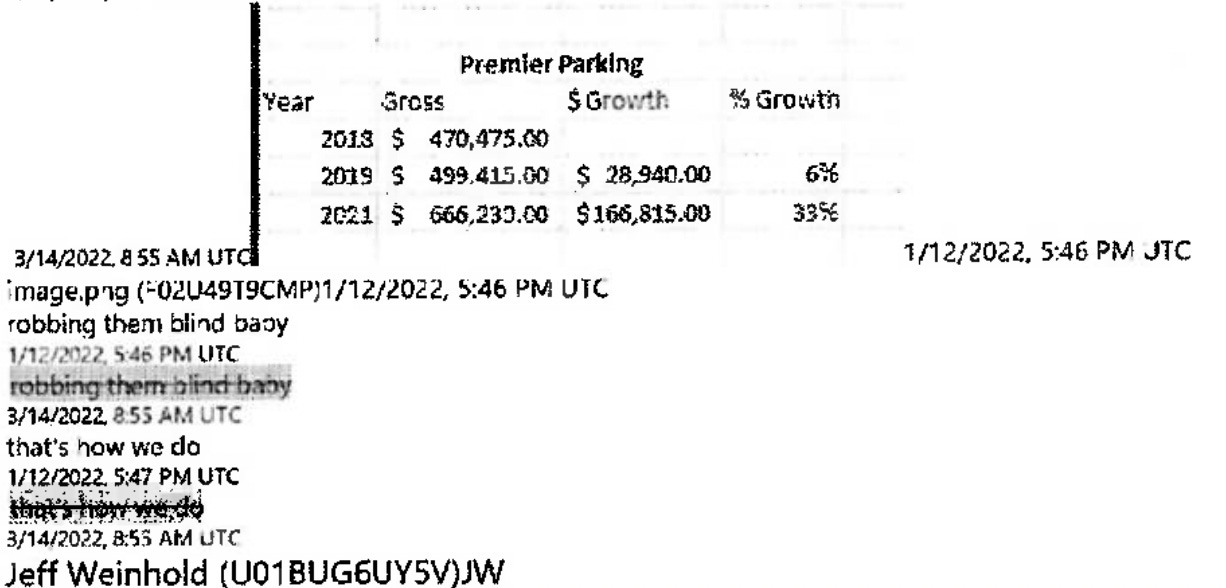
After sharing a spreadsheet showing that premier parking gross revenue had jumped from $460,475 in 2018 to 666,230 in 2021, Baker texted Weinhold, “Robbing them blind baby” and “That’s how we do.”
There are many more pages of exchanges between Weinhold and Baker. The rest are quite interesting, and perhaps I’ll go through them at some point. As for the case, expect more to come on Monday when we see the new team in action.