


Losing the federal government as a co-plaintiff a week into a major trial is rarely cause for celebration. The remaining plaintiff states, however, may have stumbled upon a silver lining with their newly hired outside counsel, Jeffrey Kessler.
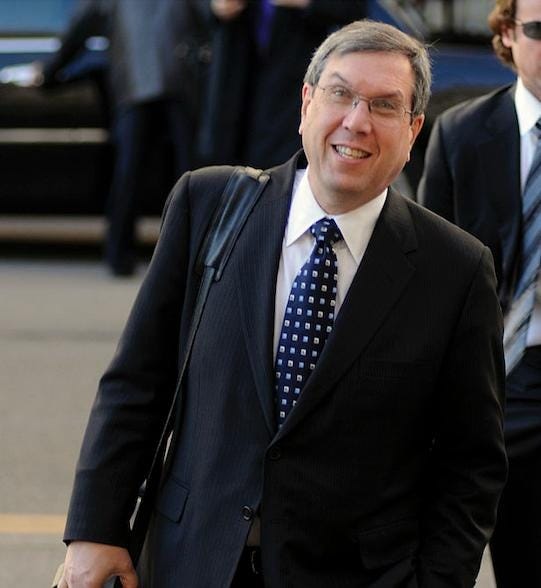
When the famed antitrust attorney took the podium for the first time today, it was immediately clear that his expertise spans both the knowledge of the law and the captivation of a courtroom.
For Ben Baker, head of ticketing for Live Nation venues, Kessler’s appearance was bad news. Baker, as I noted in an article three days ago, has become famous thanks to a trove of texts released as evidence for this case in which he casually joked with a colleague about gouging fans.
Kessler led Baker through a painstaking, line-by-line review of several messages he sent to a colleague in 2022, when both he and the colleague were managing amphitheaters for Live Nation. Baker and the colleague bet on how much they could charge fans for VIP packages and parking amenities, exchanging laughs as Baker referred to the paying fans as “stupid,” writing “I almost feel bad taking advantage of them.”
Baker responded to the barrage of texts with “unfortunately” and “regrettably” several times over, and he said that these texts were an immature way conveying his surprise that the demand existed to charge such high amounts.
The real kicker in the direct examination came when Kessler got to Baker’s “robbing them blind” text. Baker had sent his colleague a chart showing revenue increases from VIP parking over time. “In truth sir, what you really were doing there, in your words, was ‘robbing them blind baby. That’s how we do,’” Kessler read from the screen.
Jurors’ eyes widened as the message was read aloud.
In a standard antitrust trial, these messages would undoubtedly be embarrassing but might not impact the outcome of the case. The vast majority of antitrust cases are decided solely by judges, who are trained to limit their evaluation to logic and the law. In this case, because the states are seeking damages in addition to injunction, a jury is present. Juries bring to bear emotions and passions, and they are told to rely on their own memory of evidence presented during the trial.
Kessler spent part of the day trying to strengthen claims about Live Nation using anti-competitive tactics to squeeze competitors. He questioned former Live Nation chief operating officer Mark Campana about emails showing that another Live Nation employee, Brad Wavra, had repeatedly told venues that if they wanted Live Nation Entertainment shows, they needed to switch their ticketing service from AXS (AEG) to Ticketmaster. Kessler then walked Campana through a laundry list of small venues and promoters the company bought and converted into Live Nation/Ticketmaster machines.
To suggest that these acquisitions were motivated by the desire to stymie competitors, Kessler presented Campana with an email he received in 2015, which listed strategic justifications for buying the Verizon Wireless Amphitheater in Alpharetta, Georgia:
Consolidate the Atlanta outdoor venue market, which is a top 10 market.
Stop the threat of AEG from acquiring the venue and entering the Atlanta market, where they currently have no venue market.
If AEG were to acquire Alpharetta it would threaten the existing ticket market contract in place there i.e. potential lost business.
Should be considerable talent savings in the first few years since Alpharetta at times has made excessive offers to artists to lure them to the venue. At times, we have had to raise our offers to compete, therefore artificially inflating the artist value in the market.
According to Campana, Live Nation acquired these small and regional companies across the country to fill existing holes the company had in its national network. By gaining access to venues and promoters specialized in local markets, the company could improve its tours and events.
Oddly, the plaintiffs’ final witness of the day, Ben Lovett, ended up offering support for Campana’s point. Lovett, a guitarist for the band Mumford & Sons and an owner/operator of the Orion Amphitheater in Huntsville, Alabama, testified via recorded deposition. To him, Live Nation is just another competent concert promoter. During the Mumford & Sons summer 2025 tour, the band used multiple promoters, including but not limited to Live Nation. The band is currently on a tour primarily promoted by Live Nation, but Lovett said they chose the company because “someone’s got to promote those shows and they are one of the best promoters and the relationship has served us well.”
Even worse for the plaintiffs, Lovett’s Huntsville amphitheater has an exclusive ticketing contract with AXS (AEG’s ticketing service) that it doesn’t appear too happy with. Lovett said the response to AXS at the venue has been mixed, with one of its flaws being that it is less technologically developed in ticket segmentation than he understands Ticketmaster to be. To be honest, I’m not sure why the plaintiffs’ called Lovett. But that might be the cost of having an under-prepared legal team litigating the case.
More soon.