Gigi Liman is a reporter based in New York City. She is covering the Live Nation monopolization trial for Big Tech on Trial.
In 2009, Ticketmaster was facing an existential threat. The world’s largest concert promoter, Live Nation Entertainment, the result of a roll-up of promoters, was sponsoring a rival ticketing service to displace Ticketmaster. The ticketing company had been a monopoly for decades, after buying a series of rivals in the 1980s and early 1990s. It had fought well-publicized fights with the band Pearl Jam to preserve its monopoly, and won. But this time, Live Nation had the market power to invade its turf.
Instead of competing and lowering profit margins, however, Ticketmaster and Live Nation chose to merge. It was bitterly controversial, with much of the industry opposed and warning about the perils of such a move.
The Antitrust Division began investigating, and heard wails of criticism. Critics warned that this merger would create an industry monolith which would squeeze ticketing competitors and promoters, limit venue choice, and ultimately raise the costs for fans. The live music business depends on an interlocking web of these players: promoters to organize tours, venues to host them, ticketing services to distribute seats, artists to perform, and fans to fill the room. Consolidate most of those services under one roof, so went the argument, and you have all the ingredients for coercion.
Nevertheless, the Obama administration, led by AAG Christine Varney and a subordinate named Gene Kimmelman, allowed the combination, reshaping the live entertainment business into a series of alleged interlinked monopolies.
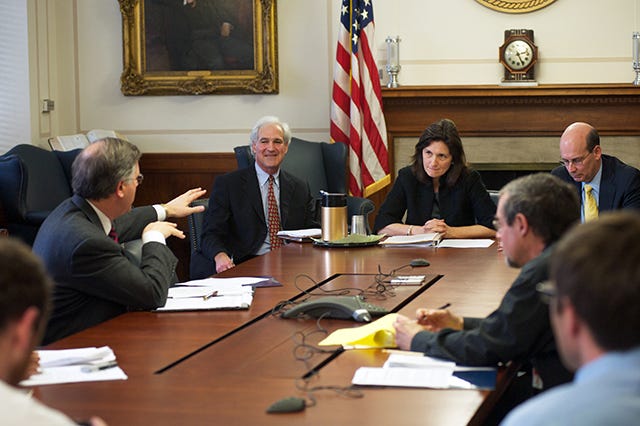
Why? Well, the Obama administration broadly speaking did not see industry complaints as particularly relevant to market power. Here’s Varney at the time, explaining the decision to allow the transaction.
In the course of investigating this merger, we heard many complaints about trends in the live music industry, and many complaints from consumers about Ticketmaster. I understand that people view Ticketmaster's charges, and perhaps all ticketing fees in general, as unfair, too high, inescapable, and confusing. We heard that it is impossible to understand the litany of fees and why those fees have proliferated. I also understand that consolidation has been going on in the industry for some time and the resultant economic pressures facing local management companies and promoters. Those are meaningful concerns, but many of them are not antitrust concerns.
Live Nation entered into a consent decree with the government. It promised not to engage in anti-competitive conduct, including retaliation against venues that chose ticketing services other than Ticketmaster. The DOJ required licensing of ticketing software and a small ticketing spinoff, which never picked up traction in the market as an independent platform. The decree never delivered the promised competition, and was revisited several times by the government.
Finally, in 2024, the Antitrust Division, along with 39 states and the District of Columbia, filed a monopolization complaint against Live Nation and Ticketmaster, alleging they are engaging in unlawful anticompetitive behavior to maintain a monopoly in key sectors of the live entertainment industry. The DOJ’s goal? To break up the companies and award damages to the states for harm allegedly caused by the conduct.
While the monopolization case is reasonable, it’s important to note that it’s been a very weird couple of years since its filing. While the complaint was brought under Biden, it’s the Trump administration that oversaw most of the litigation strategy under Assistant Attorney General Gail Slater. And yet Slater was recently fired, allegedly at the behest of a lawyer/lobbyist, Mike Davis, who is apparently on retainer by Ticketmaster. The new acting head of the Division, Omeed Assefi, chose to take this one to trial.
At the same time, the pre-trial litigation has not gone particularly well for the government. The judge, Arun Subramanian, ruled in a cramped and technocratic opinion to allow the case to go to trial, but dismissed key claims, including the government’s allegation that Live Nation has a monopoly in concert promotion industry. He also said much of the government’s economic expert analysis was not credible. After Subramanian’s ruling, Live Nation asked the judge to pause the case to let them appeal, but he refused. Still, it doesn’t seem like the government’s legal team, overseen as it is by a chaotic and ineffective political leadership, has been firing on all cylinders. Importantly, the Antitrust Division has filed monopolization charges, but not a violation of merger law, which makes it harder to bring in the original consent decree from 2010.
The argument is something along the following: Live Nation owns or exclusively books roughly 60 percent of large amphitheaters in the United States. According to the DOJ, artists who want to perform at major amphitheaters controlled by Live Nation are steered into using Live Nation’s promotion services–and, by extension, Ticketmaster’s ticketing platform. Once artists are tied into promotion agreements, Live Nation controls where those tours go. Independent venues that want to host one of the 7,000 artists Live Nation promotes must take Ticketmaster’s ticketing services to secure access to the artist. Live Nation allegedly uses threats to take artists elsewhere followed by long-term exclusivity agreements to lock venues into using Ticketmaster as their sole ticketing service.
Live Nation, naturally, will dispute all claims. They oppose the DOJ’s market definitions and will assert that they are merely running an effective and efficient live entertainment operation. They argue that venues prefer long-term exclusivity agreements with ticketing services, and that opaque fees and high prices are a result of supply and demand.
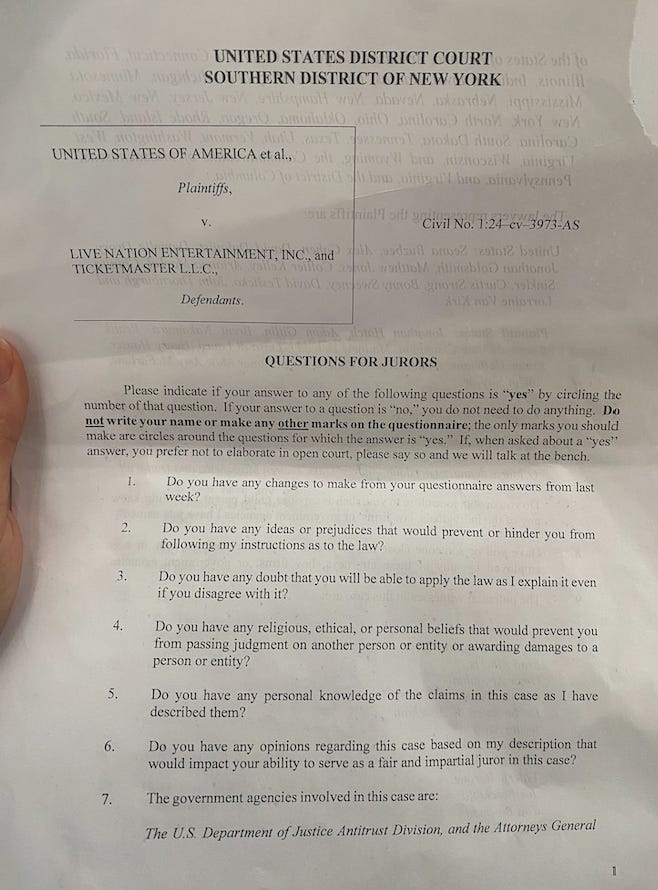
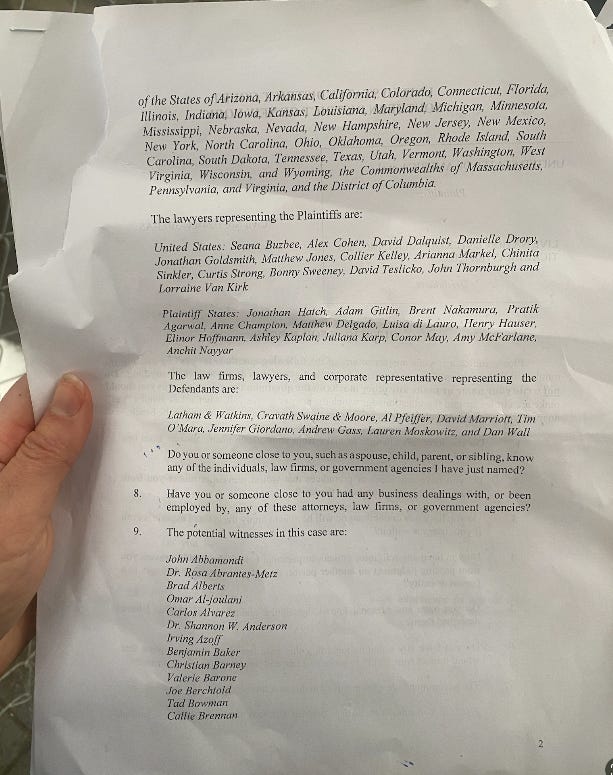
Yesterday morning, the trial finally kicked off. And while I’d like to say it started with a bang, it was a pretty staid process of jury selection. The judge was firm but humorous—though of course everyone in court always laughs at a judge’s jokes. There were 70 prospective jurors, among the few able to commit to what could be a six-week trial and to weigh the evidence without bias toward either Live Nation or the government.
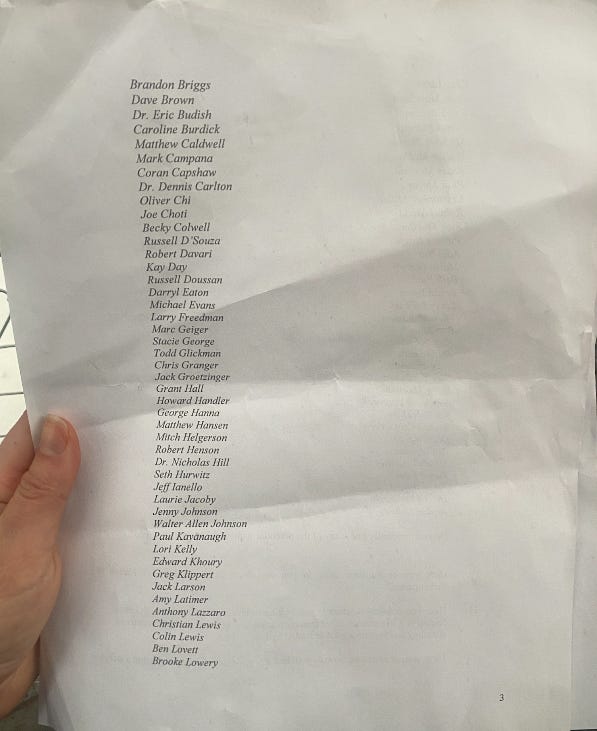
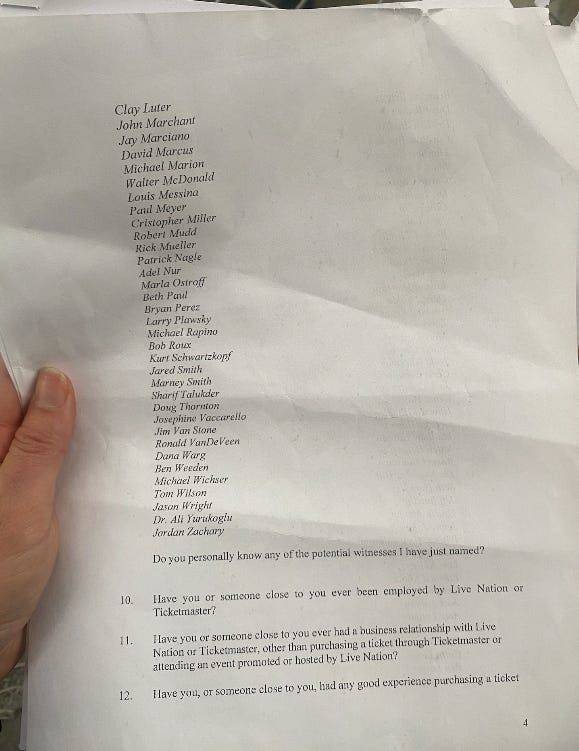
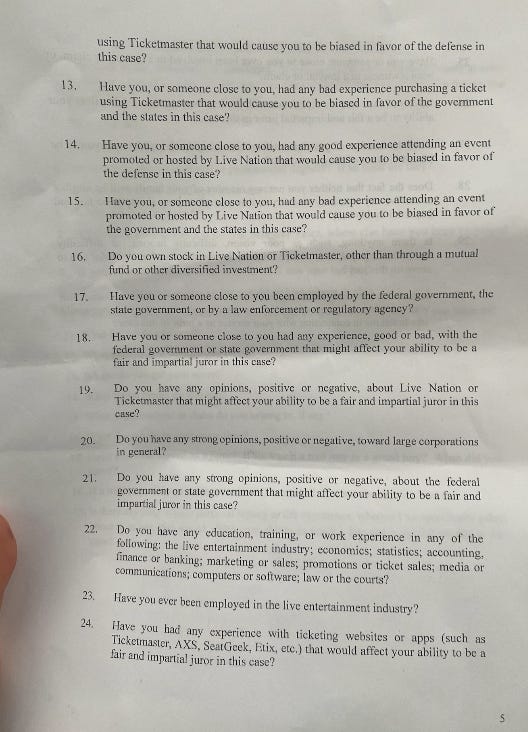
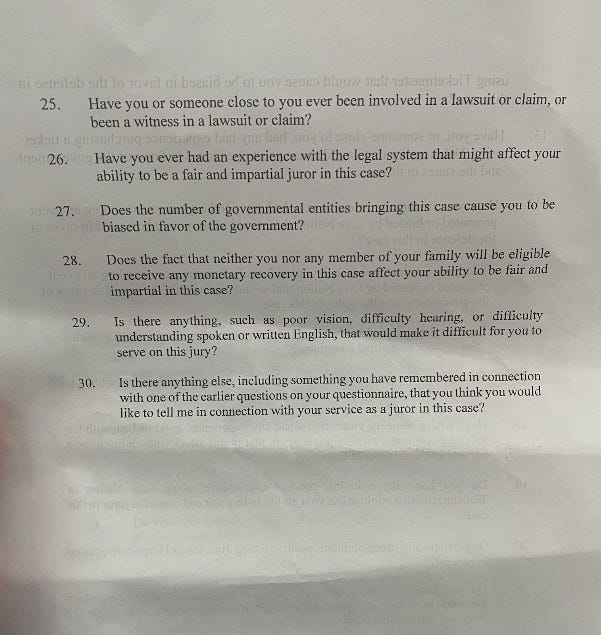
Potential jurors were asked about everything from bad experiences with Ticketmaster to whether they own stock in the firm to general attitudes towards big corporations. I put actual snapshots of the questions at the bottom of the post.
The future of Live Nation now rests in the hands of twelve men and two women, including a USPS worker, a retired teacher, an unemployed 25-year-old, a doctor and Citi-group employee. That this case will be decided by a jury is unusual. Civil antitrust cases of this size typically focus solely on injunctive relief and are decided by a judge. Here, because the plaintiffs are seeking monetary damages in addition to the break-up of these companies, the parties are entitled to a jury verdict. We can expect to hear the verdict shortly after the trial concludes.
In deciding the case, the jury will revisit the question laid before regulators in 2010: can the nation’s dominant promoter and dominant ticketing platform operate under one roof without crossing the line into illegal monopoly power.
Today I’m in the courtroom listening to opening statements. The first witness is John Abbamondi, former CEO of BSE Global, which owns the Barclay Center. Tomorrow, I’ll tell you how it went. Thanks for reading.