


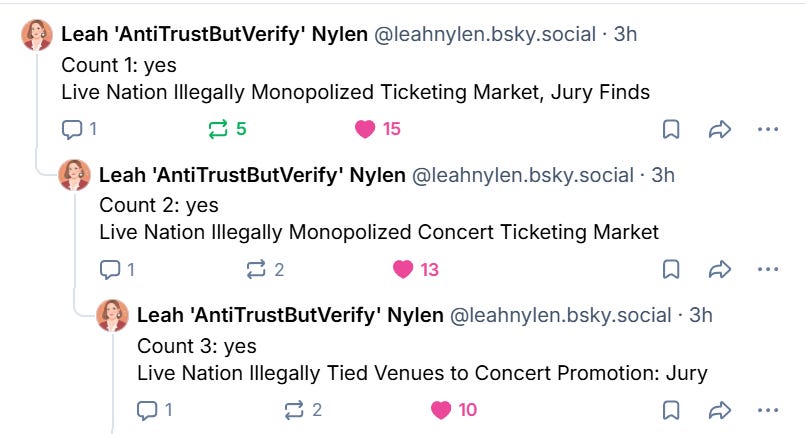
It’s official: Live Nation Entertainment has maintained an illegal monopoly.
After nearly four full days of deliberation, the jury returned a sweeping verdict. Those of us in the courtroom listened intently as it was read: Live Nation and Ticketmaster were found to have run an illegal monopoly in violation of Section 2 of the federal Sherman Antitrust Act and many state unfair competition laws.
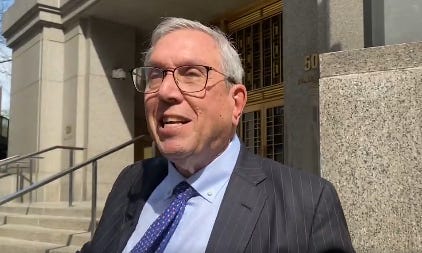
“It’s a great day for antitrust law, it’s a great day for consumers, and this case is a tribute to the 34 states and the District of Columbia who carried this case forward,” said Jeffrey Kessler, chief counsel for the plaintiffs, as he exited the courtroom. “It was my great honor to be working together with everyone on this.”
This was what trial lawyers call a “complete victory”: the jury ruled the same way—for the plaintiff states—on all counts, including on monopolization of multiple distinct markets (involving both major concert venues and large amphitheaters) and a tying claim.
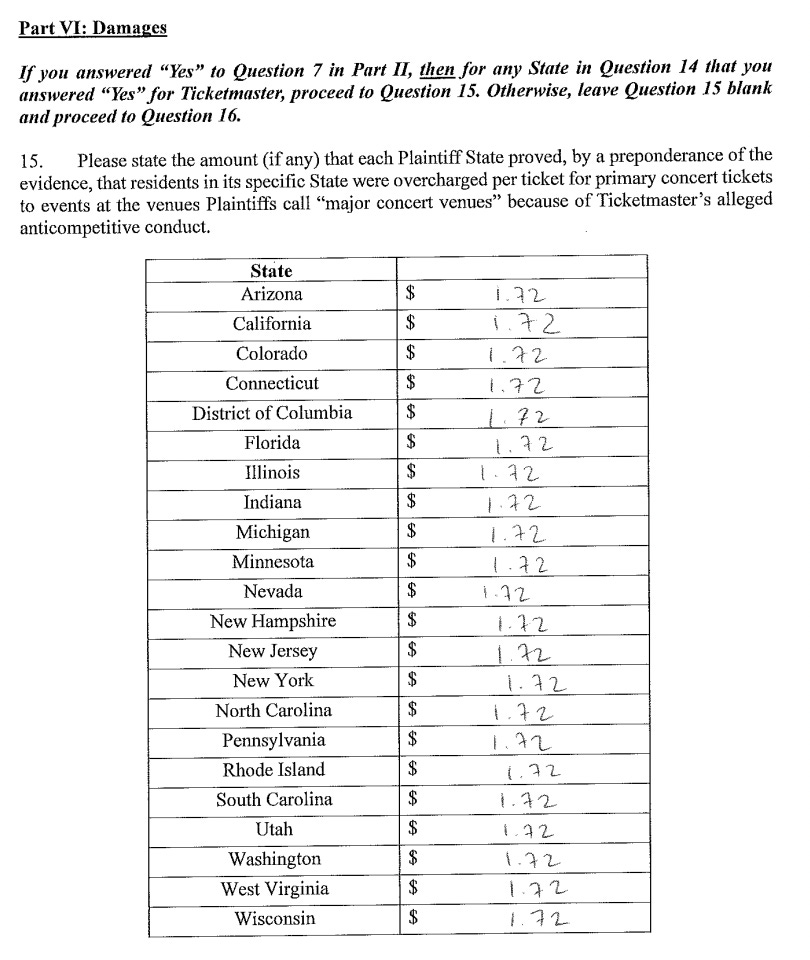
But the victory was extra “complete” in that the jury also fully upheld the plaintiffs’ theory of harm. They awarded damages at the maximum amount calculated by Dr. Rosa Abrantes-Metz: $1.72 for each ticket sold in each state and D.C. If upheld, that figure will total in the hundreds of millions of dollars.
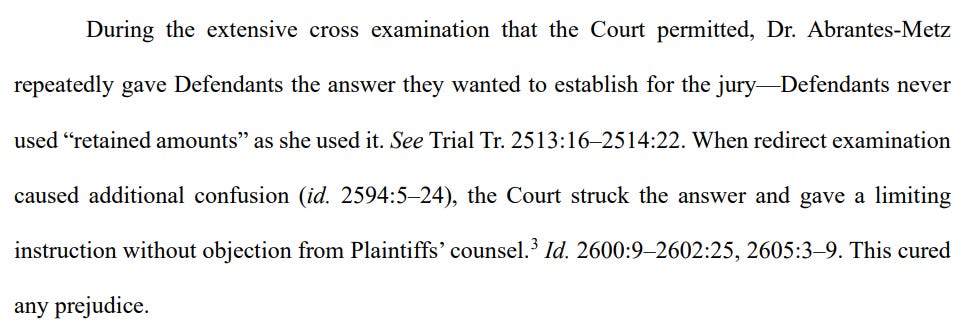
Abrantes-Metz’s testimony had been at the center of intense disputes outside the presence of the jury, with the defense accusing her of perjury and other evidentiary misdoings. The judge is still considering a motion related to the reliability of her calculations. The jurors, however—who saw some of the back and forth that cut back on her answers in real time—appeared to find her testimony trustworthy and compelling.
When asked which expert resonated the most, the foreperson, who declined to be identified, said, “They were all very good,” before adding, “I think Dr. Abrantes-Metz was very good in her expertise and how she demonstrated economically the impact on the consumers.”
The jurors took their time to wade through the evidence and “be mindful,” as the foreperson phrased it. Several pieces of evidence proved key for the plaintiffs’ case. “There were a couple emails—the tone, the language they used,” that stood out, the foreperson said. When I asked about the lawn chairs and the now-infamous “robbing them blind” quote, she said those “stuck in the head of everybody as evidence.”
The final outcome now rests on Judge Subramanian, who will determine whether the company faces structural remedies, including a possible breakup. He will also rule on the defense’s motion for judgment as a matter of law, which essentially seeks to dismiss the case due to insufficient evidence. (Such motions are often essentially perfunctory paperwork to preserve appeal rights, but the judge appeared to be taking this one seriously).
Meanwhile, the stock market appears to be taking the risk of real consequences seriously; Live Nation’s stock went down by more than 6%—while its competitors’ went up by 5% (StubHub) and 9% (Vivid Seats).
Dan Wall, an executive vice president and chief legal officer at Live Nation Entertainment, said after the verdict that the company is “disappointed but there’s a lot more game to play,” referring specifically to the defense’s motion for judgment.
That Live Nation and Ticketmaster are being held liable by a group of lay citizens, rather than a judge, is particularly poignant. As Judge Subramanian closed the trial, he told the jury that their devotion to this case, day in and day out, had given him “hope for our democracy and for our country.”
The jurors echoed a similar sentiment. The foreperson said the experience gave them “faith in the system again; as a citizen we can still make a difference.”
As the foreperson spoke to the press, the others waited nearby. Then they walked down the same block they had walked every day for the past several weeks. “Can we take one quick picture on the steps?” one of them asked. They gathered together, smiling, and took a photo—marking the end of a case that has bound them together as the group that found Live Nation liable.
Let's see if the award holds. Thank you for your hard work on reporting on this trial.
I was not expecting this, despite the damning emails and texts.
What are the chances of the judge ruling that a structural change is required? If nothing changes (other than better internal communications hygiene), is this a sufficient deterrent to Ticketmaster's future business transactions?