


The first day of the federal antitrust trial against Live Nation Entertainment and its ticketing subsidiary Ticketmaster opened Tuesday morning in the Southern District of New York with a blunt accusation from the government: “The concert industry is controlled by a monopolist.”
Over the next several weeks, David Dahlquist, the chief counsel for the plaintiffs, said the government would tell the “story of the past 16 years,” the period since the 2010 merger that fused the country’s largest concert promoter with its biggest ticketing platform.
Plaintiffs Make Their Case
Dahlquist structured his argument around two types of venues over which Live Nation and Ticketmaster hold control.
The first is amphitheaters: outdoor venues designed specifically for concerts, often seating thousands. The government contends that Live Nation owns or exclusively books (through its promoters) over 70 percent of these venues. The second is what it refers to as “major concert venues,” a category that includes all 8,000+ seat venues that host at least 10 concerts a year, including arenas and large amphitheaters. Ticketmaster has an 86 percent market share in primary ticket sales of those major concert venues.
That dominance, Dahlquist said, strips artists and venues of meaningful choice, a cornerstone of competition. Artists who want access to Live Nation–controlled amphitheaters are pressured to use the company’s promotion services, he said. Venues are effectively compelled to sign long-term, exclusive ticketing agreements with Ticketmaster or risk threats and retaliation, including the loss of concerts promoted by Live Nation.
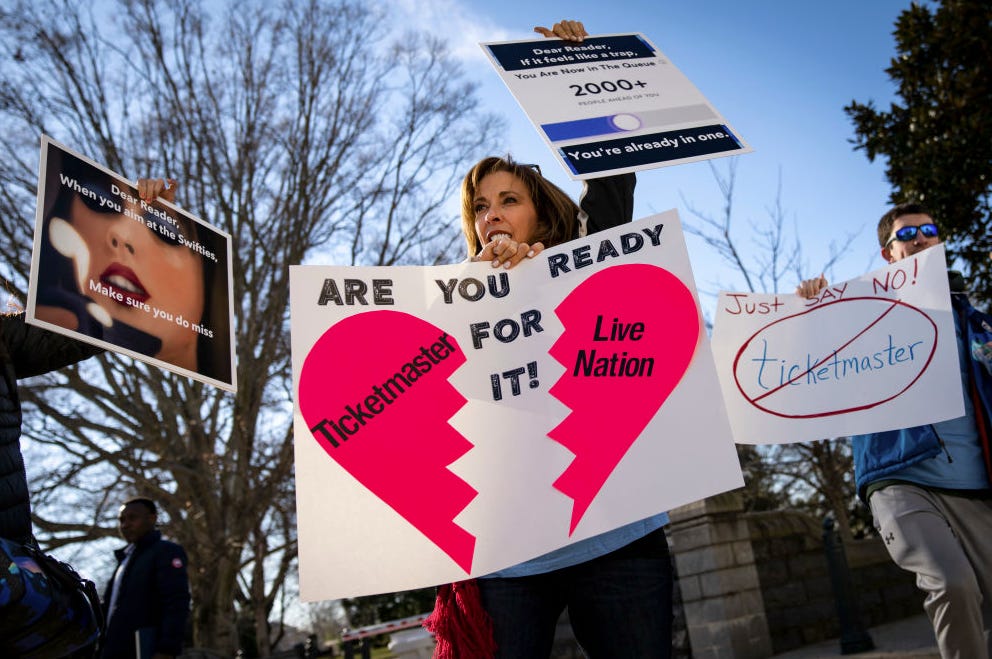
Dahlquist argued that the company did not rise to the top by building a better product. Referencing the infamous 2022 Taylor Swift ticketing fiasco, he said the company prioritized expansion over infrastructure and that “their technology is held together by duct tape, they have prioritized growth over actually maintaining their systems.” He also noted that the company’s customer service goal is to resolve just 50% of claims, and they don’t even accomplish that.
The result is that ticket fees are higher than ever. When venues leave Ticketmaster, Dahlquist said, fees decrease by over $3 per ticket, and when they go back to Ticketmaster, fees increase again.
For the last 20 minutes of the plaintiffs opening, Jonathan Hatch, speaking on behalf of the states, who are seeking damages, briefly hammered a point about comparing the percentage of ticket sales price Ticketmaster retains to that of one of its rivals, which keeps a lower share. Hatch told jurors, “This is what Ticketmaster takes just because it can.”
The Counter From Live Nation: The Magical 257
In Live Nation’s opening, chief counsel David Mariott described the venue types that make up the government’s proposed markets as “cherry picked,” claiming that the DOJ artificially narrowed the market to manufacture alleged monopoly power.
Restricting the markets as the government defined them, he said, was false. Rather than the 87 amphitheaters and 257 “major concert venues,” which he derided as the “magical 257,” he said the real marketplace includes thousands of additional venues across the United States.
“There’s nothing unique about those 87 amphitheaters,” he argued, noting that artists who play amphitheaters perform 81 percent of their shows elsewhere. To treat amphitheaters as a distinct market, he said, fails the “smell test.”
As for the major concert venue ticketing market share, Mariott placed what the plaintiffs allege is a 86 percent share closer to 40 percent when the broader universe of venues is considered. Excluding sports arenas and other facilities, he contended, distorts the competitive landscape.
Marriott presented the company as rather human-centered, hoping to act in good faith in an ultra-competitive market. After introducing himself, he introduced the rest of his legal team sitting at the counsel table, along with a few witnesses the jury can expect to testify later in the trial. He went on to describe Live Nation and Ticket Master as companies made up of “men and women who want to do the right things,” who are in a “relentless pursuit of doing good by their customers.”
He characterized Live Nation as a strengthening force for the concert industry. There are “more ticketers today than ever there has been,” he said. There are more concerts, more artists touring, and the artists are seemingly making more now than ever before, he said. He further claimed that the government has exaggerated how much the companies make, including by saying Ticketmaster makes over $7 a ticket, when it actually gets $5 but takes home less than $2 after overhead costs.
Practices that the government characterizes as threats, tying or retaliation, Marriott said, are better understood as competition. Requiring Live Nation to open its owned venues to rival promoters, he suggested, would be akin to forcing one coffee chain to sell a competitor’s product.
The long-term exclusivity agreements, which the government alleges “locks up customers (venues) for long periods of time,” are no different than Michael Jordan playing for Nike and not being able to wear Adidas, a choice that was in his interest.
The government, went the argument, is just trying to interfere with legitimate business.
Boredom in the Courtroom, Scrolling on Phones
After a lunch break, the public crowded back into the larger-than-usual courtroom, used in this case to accommodate its high-profile nature. Jurors were expected to hear from the government’s first witness: John Abbamondi, the former CEO of Barclays Center, whom both sides mentioned in their opening statements as having relevant observations about how the industry works.
About 40 minutes after the testimony was scheduled to begin, it hadn’t, and Judge Arun Subramanian informed the courtroom that the testimony would be postponed until today. The attorneys instead debated how jurors would be instructed to consider the consent decree Live Nation signed when it merged with Ticketmaster, which Abbamondi is expected to reference in his testimony.
It was clear that the crowd was less excited about this procedural back and forth than Abbamondi’s testimony. A few minutes in, the non-participating DOJ lawyers among whom I sat, started scrolling on their phones. Sounds of a sports game wafted from another person’s phone in the gallery (it’s worth noting that only licensed attorneys are allowed to have phones in the courtroom.) At that point, the court marshal started walking through the rows of benches.
Before adjourning, Judge Subramanian proposed convening at 8:30 a.m. Wednesday — thirty minutes before the jury returns — to resolve the outstanding questions. Both parties agreed, though one defense attorney quipped that if by “some miracle” they settled the issue independently, they would notify the court.
Following Abbamondi, we are expected to hear from Mitch Helgerson (Chief Resource Officer at Minnesota Wild Stadium), Marc Geiger (Chairman and CEO of live event company Gate 52) and Jack Groetzinger (CEO of SeatGeek).
I’ll have another dispatch tomorrow.