


Does Ticketmaster’s dominance in the primary ticketing market, reinforced by long-term exclusive contracts, amount to a monopoly? That is a key question in this trial, because it underpins the allegations of market power. Remember, in its settlement with the Antitrust Division, Live Nation had to give up some control of booking power.
On Friday, one of Ticketmaster’s key witnesses sat on the stand to answer this question. Jennifer Johnson, Ticketmaster’s vice president of commercial strategy, insisted that long-term exclusive deals and their early renewals were not, as the states claim, a mechanism to monopolize. They were mostly favors to venues.
These deals take place in the major concert venue market, which the plaintiffs say consists of large amphitheaters and arenas that host nine or more concerts annually. In this market, venues typically enter into exclusive agreements with ticketing providers who are granted the right to sell tickets for all events at the venue. According to the plaintiffs, Ticketmaster is the exclusive ticketing provider for roughly 86 percent of the country’s major concert venues. They argue that the company’s long-term, exclusive contracts, many of which are renewed before competitors have a chance to bid, allow Ticketmaster to maintain market power and limit competition.
Johnson acknowledged that exclusive contracts benefit Ticketmaster, but said they are primarily what venues prefer. In this trial, several venue owners have relayed this same message. Several witnesses have testified that having multiple ticketing providers would create confusion among consumers and stymie efficiency within their venue.
More surprising was Johnson’s account of contract length and early renewals. Conventional wisdom might suggest that long-term exclusive contracts, renewed without a public request-for-proposal process, would serve Ticketmaster’s interests. Johnson, however, disputed that notion. “Shorter is probably better,” she testified. The longer the deal, the more risk. When contracts are extended, she said that it is “almost always driven by the client’s request,” often because venues receive larger upfront payments that can be used for immediate capital improvements or operating needs.
Similarly, she testified that the early renewals, in which contracts are renegotiated before they expire without other competitors bidding, tend to favor venues more than Ticketmaster. These deals allow venues to replace older contracts with more favorable terms ahead of schedule. During the COVID-19 pandemic, several venues renewed early and received significant upfront payments that helped them remain financially viable.
This concept sounds fine and dandy. But when Zach Biesanz from the Minnesota State AG’s office cross-examined Johnson on behalf of the plaintiffs, it turns out that Live Nation employees are incentivized to renew venues early and to sign long-term contracts. In one Slack exchange involving Johnson and other executives, employees were instructed to “continue to aggressively pursue early renewal opportunities to avoid RFP process.”
At least until 2024, Ticketmaster’s sales staff bonuses were tied in part to securing renewals, with higher payouts for contracts signed more than six months before they were set to expire. These incentive packages also included a “term length multiplier,” through which bonuses increase along with term length. In other words, employees were paid to make agreements both earlier and longer.
The purpose of those deals, the plaintiffs suggested, was not simply to serve venues but to preserve market share. After introducing internal Ticketmaster documents showing the company exclusively ticketed 84 percent of NBA and NHL arenas, Biensaz questioned Johnson about a presentation her team prepared regarding a potential deal with an arena in Anaheim, California, where one stated goal was to “maintain majority market share of NBA and NHL.”
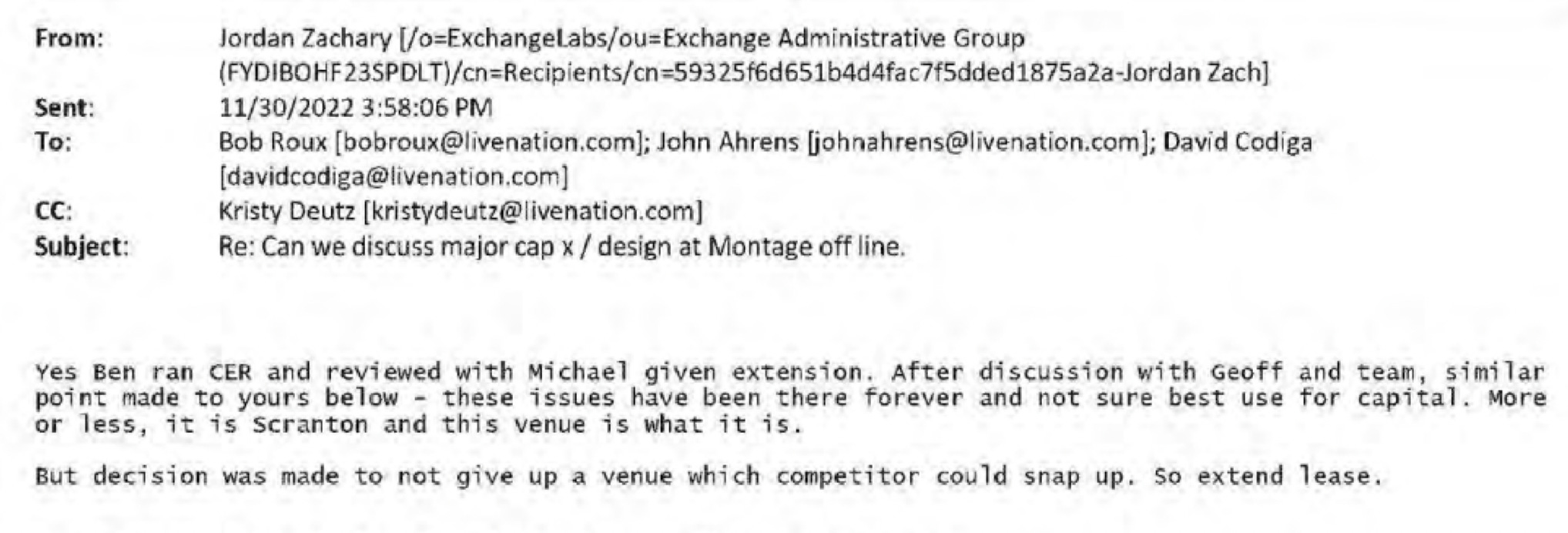
Live Nation appears to use the same playbook in renewing its exclusive venue operating agreements. Earlier this week, Live Nation CFO Ben Weeden read through emails about an amphitheater in Scranton, Pennsylvania, it exclusively operates, the Pavilion at Montage Mountain. For years Live Nation operated the amphitheater at a loss. But in 2022, as it was up for contract renewal, Live Nation chose to keep the venue. Why? Not because it was profitable, but because they didn’t want a competitor to acquire it. In their words, “a decision was made to not give up a venue which competitors could snap up. So extend the lease.”
Monday kicks off the trial’s final week. Jurors will hear from several witnesses, including a key expert for the defense. Once the jury leaves on Monday, the plaintiffs’ damages expert will enter the courtroom to answer questions related to the defense’s motion to strike her testimony. The plaintiffs submitted their responding motion late last, though it is not yet public. So get ready for some fireworks.