


Two years ago, as the Ticketmaster service malfunctioned amid the massive demand in sales for the Taylor Swift Eras tour, an expert economist criticized the ticketing company: “it’s like you’re in the Super Bowl and you fumble the first snap,” Eric Budish told the Washington Post.
On Monday, that same economist took the stand in Live Nation’s defense, a job for which he was paid a whopping $1 million.
“I do not see proof,” Budish testified, “that Ticketmaster’s high market share is because of the challenged conduct, as opposed to good old-fashioned competition on price and quality.”
As in any antitrust case, the plaintiffs’ burden is not just to show that Live Nation and Ticketmaster are big. but to explain why. If its market power flows from anticompetitive conduct, pressuring venues or squeezing competitors, that is unlawful. If it flows from offering a product that artists and venues prefer, that is competition doing what it is supposed to do.
Budish came armed as a UChicago economics professor, and brought analyses from a prestigious economic consulting firm, Cornerstone Research. His testimony was persuasive though narrow. He did not define the relevant markets, calculate Ticketmaster’s market share, or present evidence disproving the exclusionary conduct allegations. We understand future experts will cover these topics. Instead, he examined what he described as markers of high quality and low price that draw venues to Ticketmaster.
Why Ticketmaster Wins: Three Key Arguments
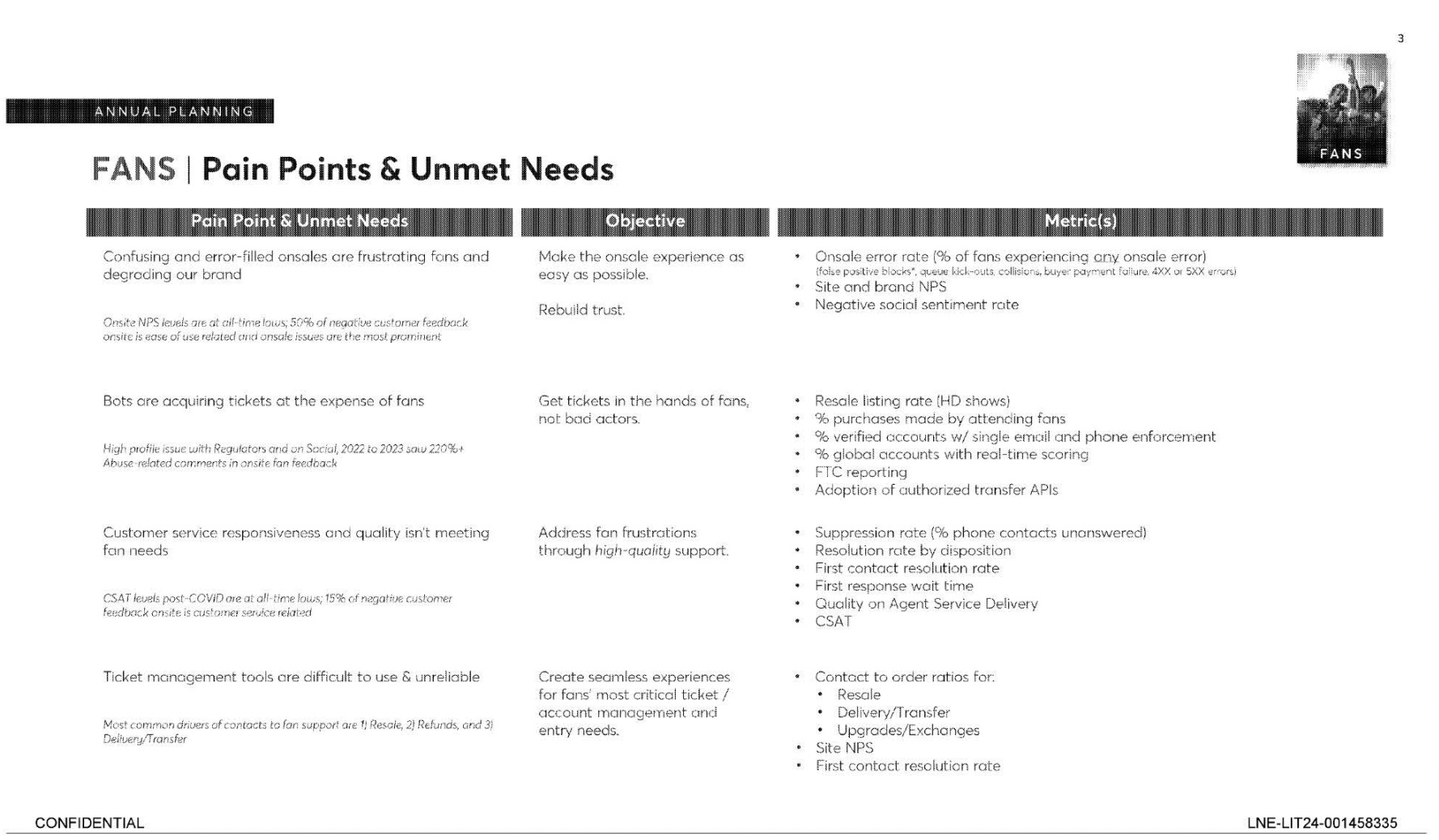
First, Ticketmaster sells more tickets per show than its rivals. According to his analysis, Ticketmaster sells 7 to 8 percent more tickets for any given show than its competitors.
Second, it has lower resell rates, meaning fewer of its tickets go to scalpers and more to fans compared to its rivals. He determined that Ticketmaster has a resale rate 7 to 12 percent lower than its rivals.
Lastly, he concluded that artists and venues make more using Ticketmaster. Using Ticketmaster’s platinum pricing tool, which allows artists to set prices for seats on an individual level, artists made over $400 million additional in 2024. He did not calculate the financial boost artists and venues receive from Ticketmaster’s competition.
According to Budish’s conclusions, these elements are the reason venues choose Ticketmaster. Not its anticompetitive conduct.
Economists’ Battle Over Barclays
If you’ve been reading Big Tech on Trial, you know that the Barclays Center drama has become a lighting rod in this trial. The arena switched from Ticketmaster to SeatGeek in 2021—a move that sparked a profanity-laced phone call between then-Barclays CEO John Abbamondi and Live Nation CEO Michael Rapino—and returned to Ticketmaster in 2023. The episode is cited by both parties’ experts as evidence supporting their arguments.
There is evidence that Live Nation retaliated against Barclays when it switched to Ticketmaster. In the year after Barclays switched from Ticketmaster to SeatGeek, its number of Live Nation concerts decreased from 23 to 14. Other NHL/NBA arenas saw no such decrease. In the year after Barclays switched back to Ticketmaster, it hosted 28 Live Nation concerts. This number has only risen year after year.
Yesterday, Budish presented the jury with a different take on the Barclays scandal. He found that artists who performed at Barclays when SeatGeek was the primary ticketing company sold fewer tickets for their shows at the venue compared to their other shows. When Ticketmaster was Barclays’ primary ticketing company, both before SeatGeek and after, artists sold more tickets at the venue than they sold elsewhere.
Did Barclays return to Ticketmaster because it sells more tickets or because Live Nation withheld content from its venue?
Capitol One Arena Exec Throws Support Behind Ticketmaster
Following Budish, Capitol One Arena executive James Van Stone testified in support of Ticketmaster. Van Stone oversees ticketing at the arena and praised Ticketmaster so highly that he extended his contract with the company two years before it was set to expire. His testimony was partially undercut when it was revealed that he is friends with the Ticketmaster executives who sign his arena’s contracts. They have provided him tickets to see Bruce Springsteen (his favorite artist) dozens of times, both domestically and abroad, sometimes paying for his tickets.
The jurors got a rude awakening when they entered the courtroom this morning. To stay on schedule, Judge Subramanian will extend proceedings next week from 9 a.m. to 5 p.m., an hour or two longer than each day thus far. We’ve already lost two jurors, and a third has raised an issue about her ability to continue serving. At least one juror celebrates Passover, so we will not be meeting on Wednesday.
The judge made sure to convene with the lawyers after the jurors left yesterday to get these details squared away. As he said, “it doesn’t pay to have surprises come up at the last minute,” an obvious nod to the parties’ tendencies to withhold information from the judge. If you missed it, he addressed this in an explosive hearing on Friday.
Today, Live Nation is continuing its defense.