


For weeks, plaintiffs have painted Live Nation as a monopolistic giant in live music. On Thursday, the company claimed in court that it is not a gatekeeper but merely a facilitator in the industry.
As the defense opened its case, Omar Al-joulani, president of touring at Live Nation and brother-in-law to CEO Michael Rapino, testified that artists, not promoters, ultimately decide where and how they tour.
“I wouldn’t say I have any power,” Al-joulani told the court. He described a competitive environment in which multiple promoters (who organize concerts and tours for artists) vie for clients. Some artists end up choosing Live Nation for their shows and tours, and others, like Taylor Swift, Ed Sheeran and Bruno Mars, don’t.
In addition to promoting artists, Live Nation owns or exclusively operates hundreds of venues across the U.S. It also owns Ticketmaster, the world’s largest ticketing company. Unlike the ticketing contracts, which have taken center stage throughout this trial, Live Nation promoters rarely lock artists into long-term agreements, meaning the company must compete regularly to win tours.
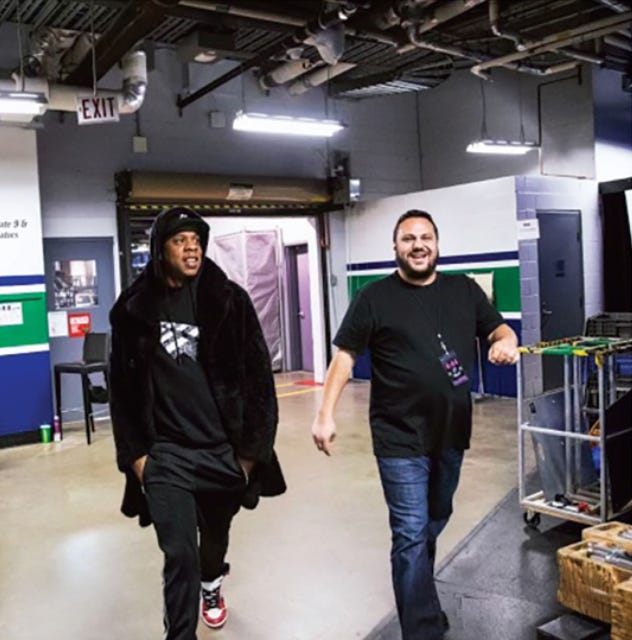
Al-joulani, who has promoted for Jay-Z, the Weeknd and Shakira, insisted that Live Nation never forces artists on where to perform, calling the company “artist obsessed” rather than “venue obsessed.” He said any recommendations to play at a Live Nation-owned or Ticketmaster-ticketed venue are because of their respective benefits, not the shared ownership. Al-joulani labeled AXS, one of Ticketmaster’s biggest competitors, as “rudimentary,” using tools that “we would have had 15, 20 years ago.” Throughout his testimony, Al-joulani seemed to subconsciously shift between referring to Ticketmaster in the first person and third person.
He also dismissed claims that Live Nation monopolizes the amphitheater market, denying the market exists altogether. Other than Jimmy Buffet, he said he couldn’t think of an artist who’s done an amphitheater-only tour.
Ticketmaster Secretly Booms from Secondary Sales
On the stand a week ago, Live Nation Entertainment CEO Michael Rapino testified that Ticketmaster only participates in the secondary ticket market—where scalpers resell tickets at inflated prices—because the industry has failed to impose regulations he has long lobbied for.
Yesterday, one of the plaintiffs’ last witnesses, Ticketmaster executive David Marcus, carried the burden of answering for Rapino’s emails that suggest otherwise.
Marcus was presented with a 2023 Ticketmaster slide deck from an executive conference that celebrated the company’s booming secondary-ticket revenue. It described the company’s resale growth outpacing total company growth, with secondary sales soaring from $2 billion in 2019 to $4.3 billion in 2022.
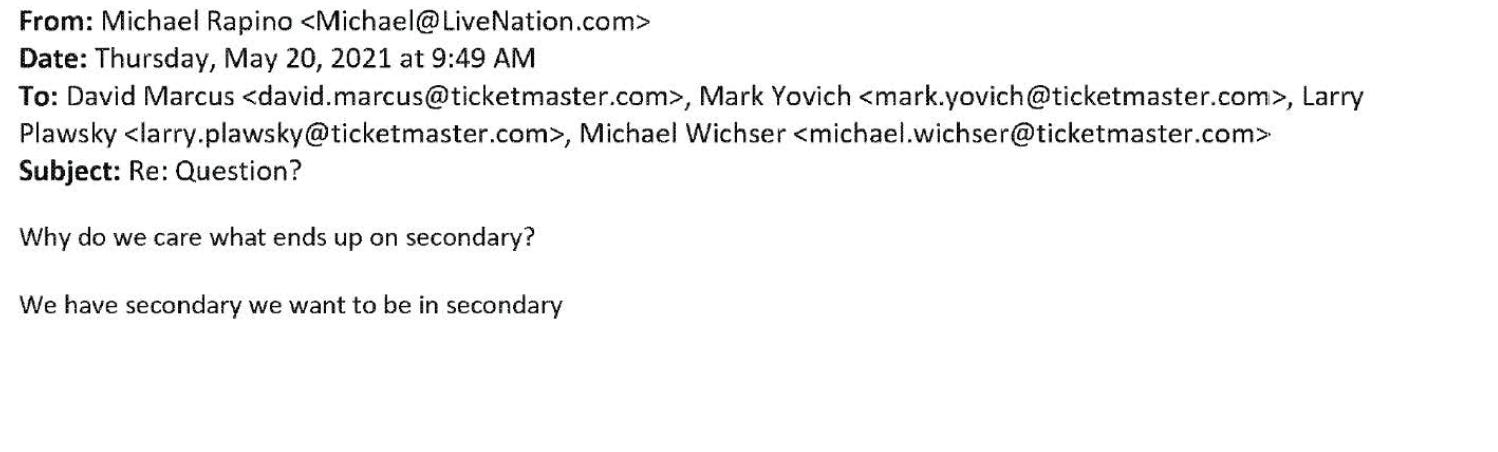
In a separate email exchange, Rapino questioned Marcus about a Ticketmaster tool designed to prevent scalpers from dominating secondary sales: “Why do we care what ends up on secondary? We have secondary we want to be in secondary.” Marcus responded that zero resale was not the goal, but that it would be a problem if brokers captured all secondary tickets while fans received none. Rapino pushed back: “I don’t want to balance artists, fans, and brokers.” Marcus reluctantly acknowledged to the court that Rapino pushed a strategy of more business in the secondary market.
Among the other damning emails was one in which Marcus suggested they “boil the frog” by increasingly capturing revenue that would otherwise go to venues and then “negotiate down from strength driven by product adoption.”
Arid Testimony in Little Rock
The last witness of the day, an arena manager in Little Rock, Arkansas appeared via prerecorded deposition. Prerecorded depositions are notoriously dry, but this one reached new heights of aridness. Extracting information from him had the tediousness of an archeological dig where the discovery only surfaces after intense time and labor.
“Are you familiar with Ticket master’s anti-fraud tools?” a lawyer asked.
“I am familiar with Ticketmaster’s anti-fraud tools,” he responded.
“Do you have an assessment of the effectiveness of these tools?”
“I have an assessment of those tools.”
Lawyers from both parties chuckled as this pattern continued. At least one juror appeared to have fallen asleep, only lifting her to head the voice of Judge Subramanian announcing that the jury would be released, saying “I will not subject the jury to any more movies right now.”